Page 1
Reprinted from JOURNAL OF PERSONALITY ASSESSMENT
Vol. 47 No. 2 Diagnosing Multiple Personalities with the Rorschach: A Confirmation
EDWIN E. WAGNER The University of Akron
RALPH B. ALLISON Morro Bay, California
and
CAROL F. WAGNER Akron, Ohio
Abstract: The Rorschach of an authenticated male multiple personality was presented. The pro- tocol was found to conform to recently developed guidelines for diagnosing the syndrome with the Rorschach, The rationale behind the decision rules and the psychodynamics of multiplicity
were discussed.
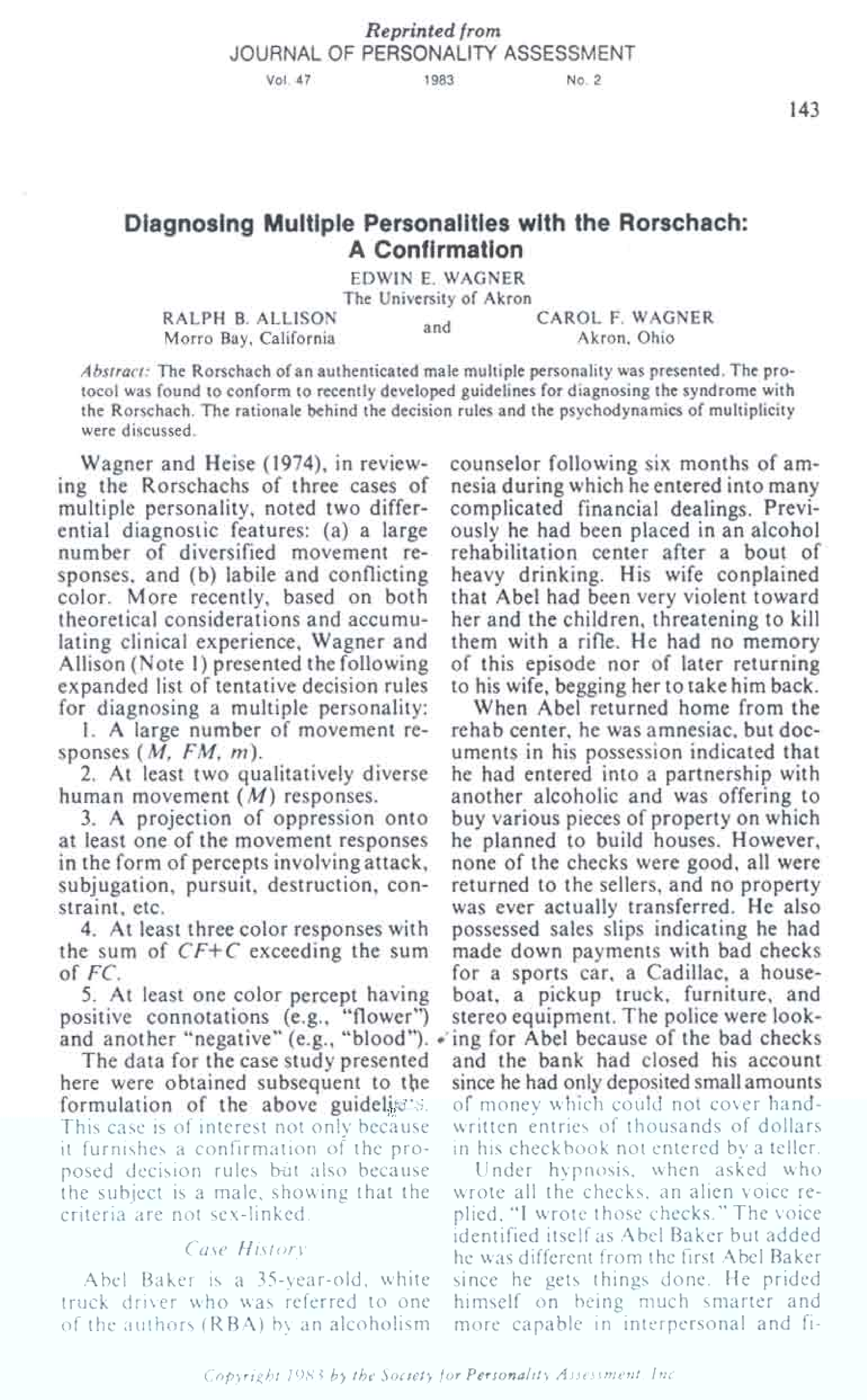
Waener and Heise (1974), in review- ing the Rorschachs of three cases of multiple personality, noted two differ- ential diagnostic features: (a) a large number of diversified movement re- sponses, and (b) labile and conflicting color. More recently, based on both theoretical considerations and accumu- lating clinical experience, Wagner and Allison (Note |) presented the following expanded list of tentative decision rules for diagnosing a multiple personality: . A large number of movement re- sponses (M, FM, m). . At least two qualitatively diverse human movement (M) responses. . A projection of oppression onto at least one of the movement responses in the form of percepts involving attack, subjugation, pursuit, destruction, con- straint, etc. . At least three color responses with the sum of CF+C exceeding the sum of FC, . At least one color percept having positive connotations (e.g., “flower”) and another “negative” (e.g., “blood”).
The data for the case study presented here were obtained subsequent to the formulation of the above guidelixs. This case is of interest not only because it furnishes a confirmation of the pro- posed decision rules but also because the subject 1s a male, showing that the criteria are not sex-linked
Case History
Abel Baker is a 35-year-old, white truck driver who was referred lo one of the authors (RBA) by an alcoholism
T
Capyright JOS? by the Soceety for Personally
counselor following six months of am- nesia during which he entered into many complicated financial dealings. Previ- ously he had been placed in an alcohol rehabilitation center after a bout of heavy drinking. His wife conplained that Abel had been very violent toward her and the children, threatening to kill them with a rifle. He had no memory of this episode nor of later returning to his wife, begging her to take him back.
When Abel returned home from the rehab center, he was amnesiac, but doc- uments in his possession indicated that he had entered into a partnership with another alcoholic and was offering to buy various pieces of property on which he planned to build houses. However, none of the checks were good, all were returned to the sellers, and no property was ever actually transferred. He also possessed sales slips indicating he had made down payments with bad checks for a sports car, a Cadillac, a house- boat, a pickup truck, furniture, and stereo equipment. The police were look-
‘ing for Abel because of the bad checks
and the bank had closed his account since he had only deposited small amounts of money which could not cover hand- written entries of thousands of dollars in his checkbook not entered by a teller.
Under hypnosis, when asked who wrote all the checks, an alien voice re- plied, “I wrote those checks.” The voice identified itself as Abel Baker but added he was different from the first Abel Baker since he gets things done. He prided himself on being much smarter and more capable in interpersonal and fi-
Asesomend’ fone
Page 2
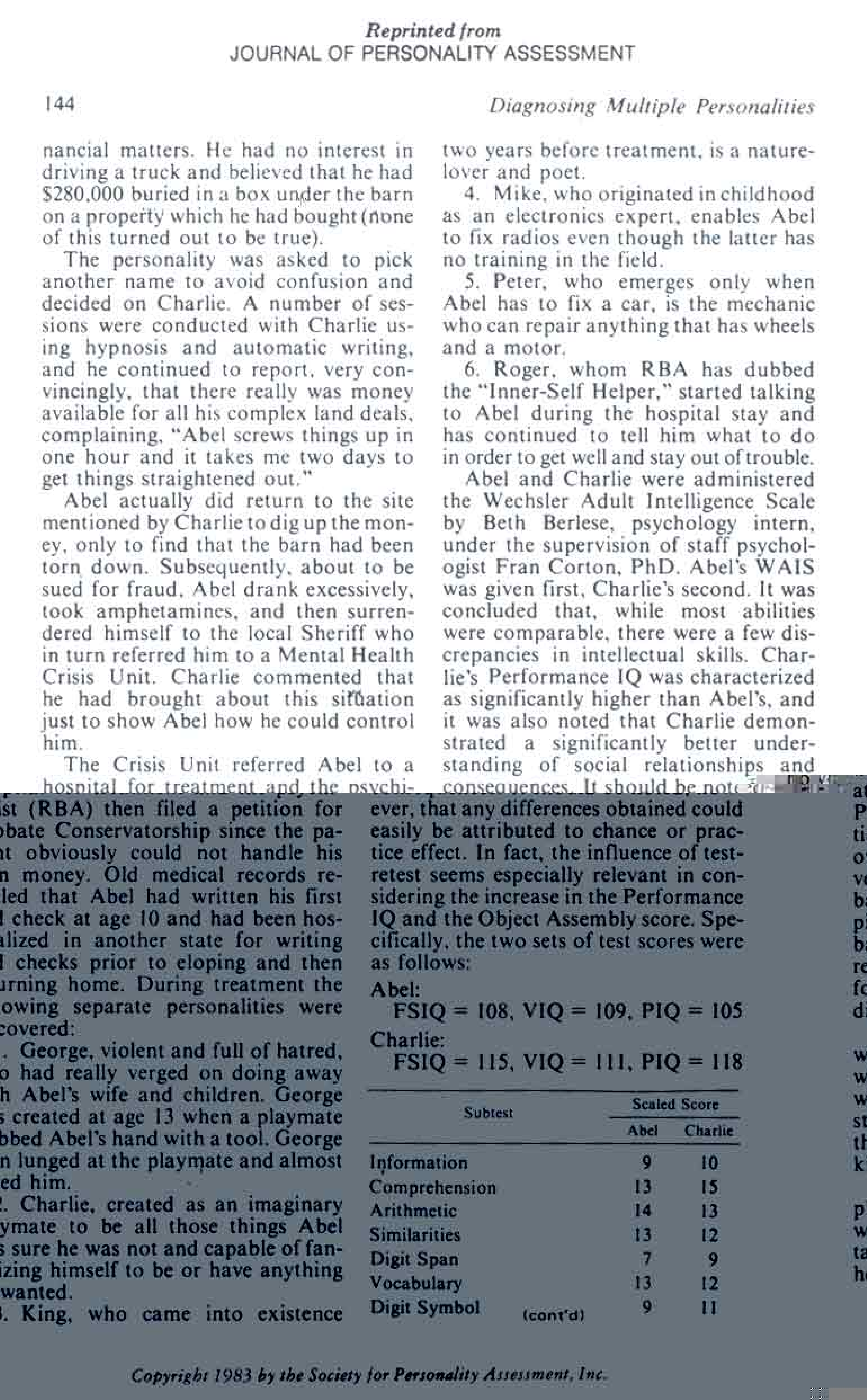
Reprinted from JOURNAL OF PERSONALITY ASSESSMENT nancial matters. He had no interest in driving a truck and believed that he had $280,000 buried ina box under the barn on a property which he had bought(none of this turned out to be true).
The personality was asked to pick another name to avoid confusion and decided on Charlie. A number of ses- sions were conducted with Charlie us- ing hypnosis and automatic writing, and he continued to report, very con- vincingly, that there really was money available for all his complex land deals, complaining, “Abel screws things up in one hour and it takes me two days to get things straightened out."
Abel actually did return to the site mentioned by Charlie to dig up the mon- ev, only to find that the barn had been torn down. Subsequently, about to be sued for fraud, Abel drank excessively, took amphetamines, and then surren- dered himself to the local Sheriff who in turn referred him to a Mental Health Crisis Unit. Charlie commented that he had brought about this siffation just to show Abel how he could control him,
The Crisis Unit referred Abel to a
‘ me o r | i | | | | i] ii
Diagnosing Multiple Personalities
two years belore treatment, is a nature- lover and poet. . Mike, who originated in childhood as an electronics expert, enables Abel to fix radios even though the latter has no training in the field. . Peter, who emerges only when Abel has to fix a car, is the mechanic who can repair anything that has wheels and a motor. , Roger, whom RBA has dubbed the “Inner-Self Helper,” started talking to Abel during the hospital stay and has continued to tell him what to do in order to get well and stay out of trouble.
Abel and Charlie were administered the Wechsler Adult Intelligence Scale by Beth Berlese, psychology intern, under the supervision of staff psychol- ogist Fran Corton, PhD. Abel’s WAIS was given first, Charlie's second. It was concluded that, while most abilities were comparable, there were a few dis- crepancies in intellectual skills. Char- lie’s Performance 1Q was characterized as significantly higher than Abel’s, and it Was also noted that Charlie demon- strated a significantly better under- standing of social relationships and OTS teen SOU De i
Page 3
Reprinted from JOURNAL OF PERSONALITY ASSESSMENT
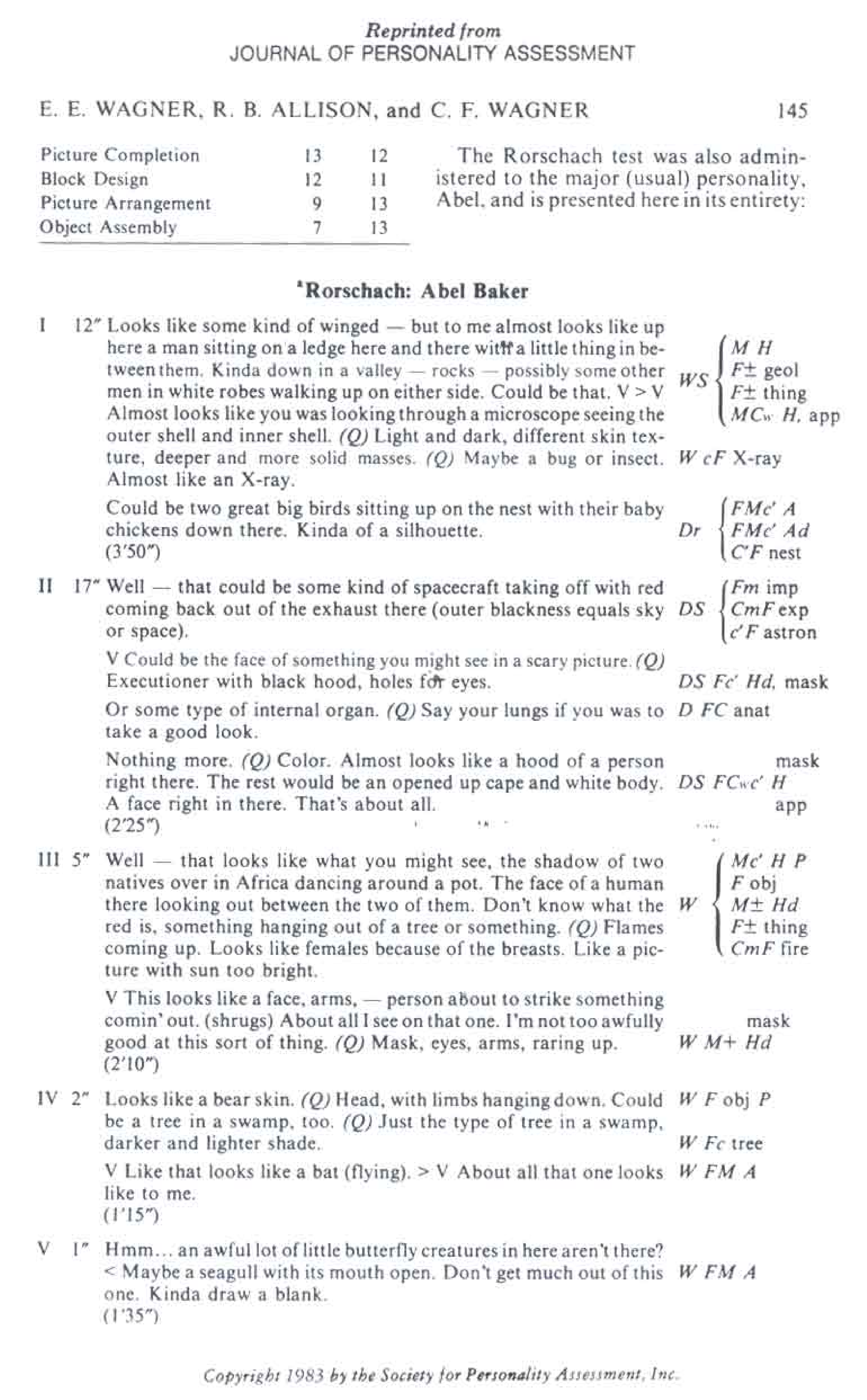
E. E. WAGNER, R. B. ALLISON, and C. F, WAGNER Picture Completion 13 12 _ The Rorschach test was also admin- Block Design }2 1] istered to the major (usual) personality, Picture Arrangement 9 13 Abel. and is presented here in its entirety: Object Assembly 7 13
“Rorschach: Abel Baker
[I 12* Looks like some kind of winged — but to me almost looks like up here a man sitting on’a ledge here and there wittfa little thing in be- tweenthem. Kinda down in a valley — rocks — possibly some other men in white robes walking up on either side. Could be that, V>V Almost looks like you was looking through a microscope seeing the outer shell and inner shell. (QO) Light and dark, different skin tex- ture, deeper and more solid masses. (QO) Maybe a bug or insect. Almost like an X-ray.
Could be two great big birds sitting up on the nest with their baby chickens down there. Kinda of a silhouette. (3'°50")
Well — that could be some kind of spacecraft taking off with red coming back out of the exhaust there (outer blackness equals sky Or Space),
I] 17*
V Could be the face of something you might see in a scary picture. (Q) Executioner with black hood, holes fdr eyes.
Or some type of internal organ. (QO) Say your lungs if you was to take a good look.
Nothing more, (Q) Color. Almost looks like a hood of a person right there. The rest would be an opened up cape and white body. A face right in there. That's about all.
(2'25") | Le
Well — that looks like what you might see, the shadow of two natives over in Africa dancing around a pot. The face of a human there looking out between the two of them. Don't know what the red is, something hanging out of a tree or something. (Q) Flames coming up. Looks like females because of the breasts. Like a pic- ture with sun too bright,
V This looks like a face, arms, — person about to strike something comin’ out. (shrugs) About alll see on that one. I'm not too awfully good at this sort of thing. (QO) Mask, eyes, arms, raring up. (2°10")
Itt 5”
IV 2" Looks like a bear skin. (QO) Head, with limbs hanging down, Could be a tree in a swamp, too, (Q) Just the type of tree in a swamp, darker and lighter shade.
V Like that looks like a bat (flying). > V About all that one looks like to me. (1°15")
VI” Hmm... an awful lot of little butterfly creatures in here aren't there? < Maybe a seagull with its mouth open. Don't get much out of this one. Kinda draw a blank.
(1°35")
Copyright 1983 by the Socsety for Personality Assesment, Inc
MH
FE geol
Ft thing MCw H, app
WS
W cF X-ray
FMc' A Dr {Far Ad C’F nest Fm imp DS + CmF exp c’ F astron
DS Fe’ Hd, mask D FC anat
mask DS FCwe’ H
app
Mec’ H P F obj
M+ Hd F thing CmF fire
mask
We M+ Hd
W’ F obj P
MW’ Fe tree HW FM A
W FM A
Page 4
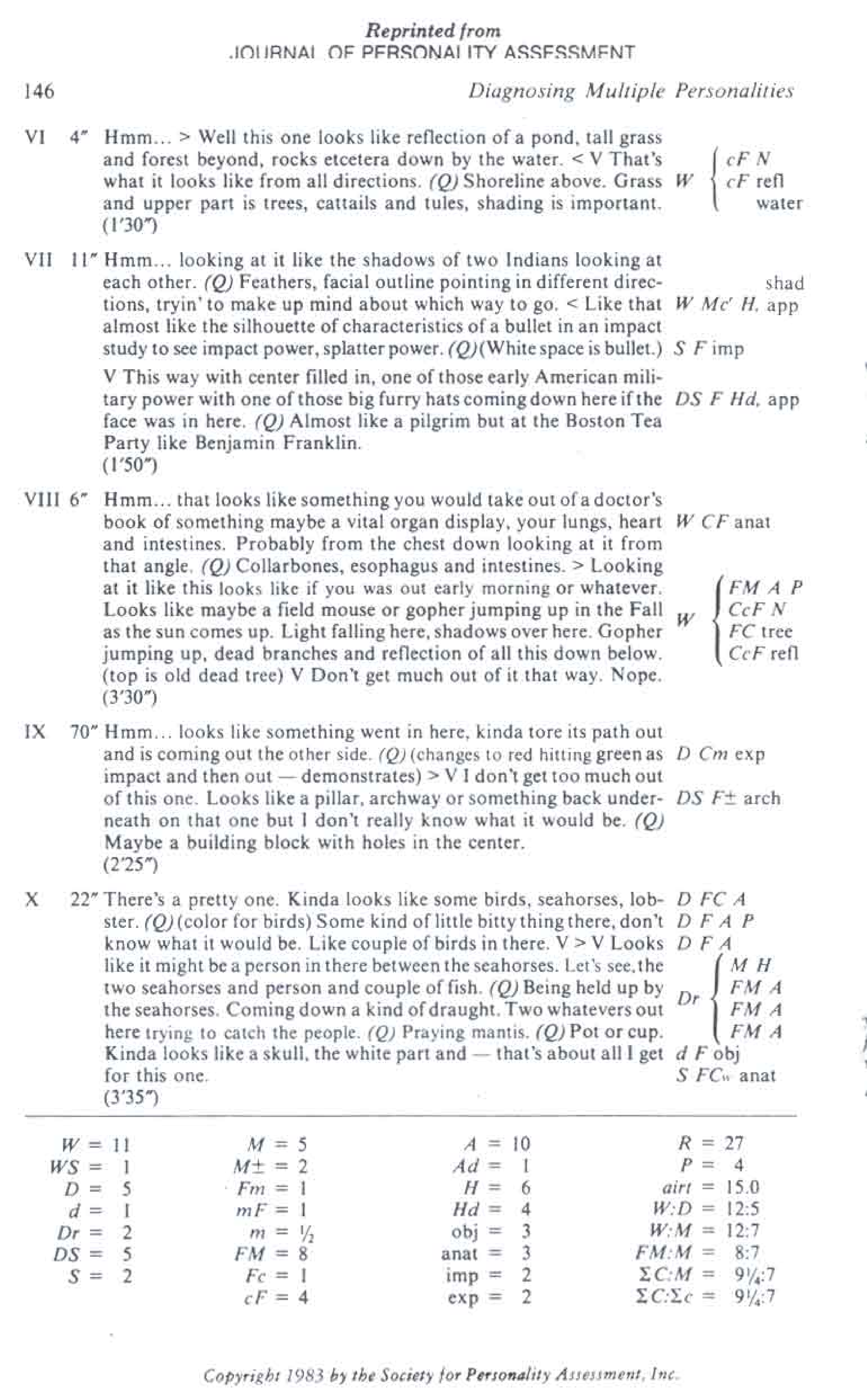
Reprinted from JOURNAL OF PFRSONAI ITY ASSFSSMENT Diagnosing Multiple Personalities VI 4" Hmm... > Well this one looks like reflection of a pond, tall grass and forest beyond, rocks etcetera down by the water. < V That's cP N what it looks like from all directions. (Q) Shoreline above. Grass Wj cF refl and upper part is trees, cattails and tules, shading ts important. water (1°30") VII il" Hmm... looking at it like the shadows of two Indians looking at each other. (Q) Feathers, facial outline pointing in different direc- shad
tions, tryin’ to make up mind about which way to go, < Like that W Mc’ H, app almost like the silhouette of characteristics of a bullet in an impact study to see impact power, splatter power. (Q)(White space is bullet.) S F imp
V This way with center filled in, one of those early American mili-
tary power with one of those big furry hats coming down here ifthe DS F Hd, app face was in here. (Q) Almost like a pilgrim but at the Boston Tea
Party like Benjamin Franklin.
(1°50")
VIII 6” Hmm... that looks like something you would take out of a doctor's book of something maybe a vital organ display, your lungs, heart HW’ CF anat and intestines. Probably from the chest down looking at it from that angle, (QO) Collarbones, esophagus and intestines. > Looking
at it like this looks like if you was out early morning or whatever. FM AP Looks like maybe a field mouse or gopher jumping up inthe Fall ,, J CcF N as the sun comes up. Light falling here, shadows over here. Gopher FC tree jumping up, dead branches and reflection of all this down below. CeF refl (top is old dead tree) V Don’t get much out of it that way. Nope.
(3°30")
IX 70” Hmm... looks like something went in here, kinda tore its path out and is coming out the other side. (Q) (changes to red hitting greenas D Cm exp impact and then out — demonstrates) > V 1 don’t get too much out of this one. Looks like a pillar, archway or something back under- DS F> arch neath on that one but | don’t really know what it would be. (Q) Maybe a building block with holes in the center. (2°25")
X 22” There's a pretty one. Kinda looks like some birds, seahorses, lob- D FC A ster. (Q) (color for birds) Some kind of little bitty thingthere,don't D F A P know what it would be. Like couple of birds inthere. V> V Looks DF A like it might be a person in there between the seahorses. Let's see, the MH two seahorses and person and couple of fish. (Q) Being held up by Dr FMA the seahorses. Coming down a kind of draught. Two whatevers out FM A here trying to catch the people. (Q) Praying mantis. (Q) Pot or cup. FM A Kinda looks like a skull, the white part and — that’s about alll get d F obj for this one. S FCw anat (3°35") Y= 11 M = 5 A = 10 R = 27 WS = | M+ =2 Ad= | P= 4 D= § -Fm = 1 H= 6 aire = 15.0 d= | mF = | Ha = 4 W:D = 12:5 Dr= 2 m=, obj) = 3 WeM = 12:7 DS = § FM =8 anat = 3 FM:M = 8:7 §= 2 Fe = | imp = 2 LCM = 9:7 ck =4 exp = 2 LC:Le = 97
Copyright 1983 by the Socsety for Personality Assesment, Inc
Page 5
Reprinted from JOURNAL OF PFRSONAI ITY ASSFSSMENT
E. E. WAGNER, R. B. ALLISON, and C. F. WAGNER
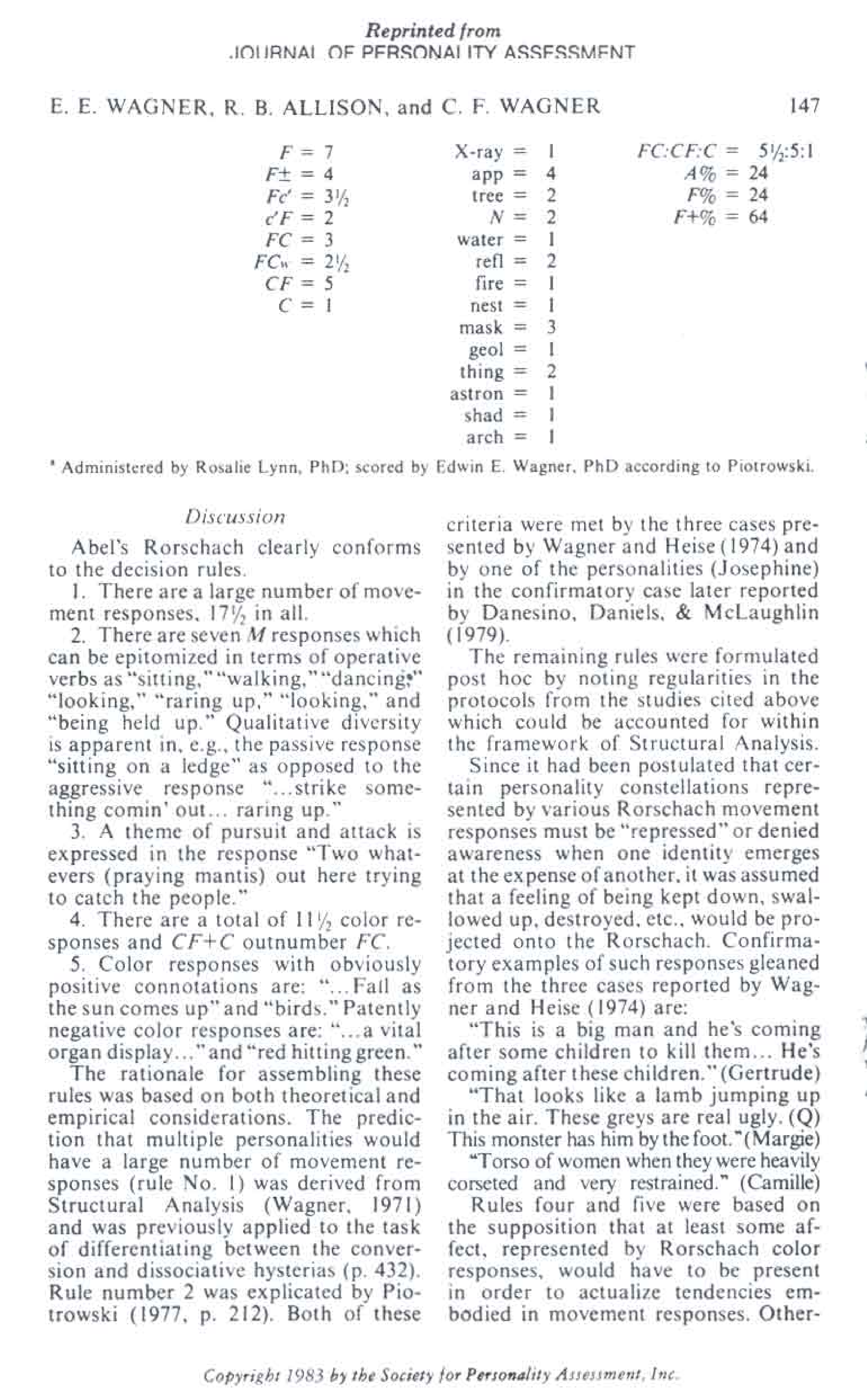
F=7 Fr=4 Fo = 34, oF =2 FC = 3 Foy = 2, CF =5 C=! FOCCFE:C = S'A4:5:1 A% = 24 FQ = 24 F+% = 64
A-Tay app tree
N Water refl fire nest mask geol thing astron shad arch
pnunrnb ob nwt wen wet
——_e ee f= iW = FJ he a
"Administered by Rosalie Lynn, PhD; scored by Edwin E. Wagner, PhD according to Piotrowski,
Oiscussion
Abel’s Rorschach clearly conforms to the decision rules.
]. There are a large number of move- ment responses. 17'/ tn all, . There are seven M responses which can be epitomized in terms of operative verbs as “sitting,” “walking,” “dancings” “looking,” “raring up,” “looking,” and “being held up.” Qualitative diversity iS apparent in, ¢.g., the passive response “sitting on a ledge” as opposed to the aggressive response “...strike some- thing comin’ out... raring up.” . A theme of pursuit and attack is expressed in the response “Two what- evers (praying mantis) out here trying to catch the people.” . There are a total of I1'/, color re- sponses and CF+C outnumber FC, . Color responses with obviously positive connotations are: “,..Fall as the sun comes up” and “birds.” Patently negative color responses are: “...a vital organ display...” and “red hitting green.”
The rationale for assembling these rules was based on both theoretical and empirical considerations. The predic- tion that multiple personalities would have a large number of movement re- sponses (rule No. |) was derived from Structural Analysis (Wagner, 1971) and was previously applied to the task of differentiating between the conver- sion and dissociative hysterias (p. 432). Rule number 2 was explicated by Pio- trowski (1977, p. 212). Both of these
criteria were met by the three cases pre- sented by Wagner and Heise (1974) and by one of the personalities (Josephine) in the confirmatory case later reported by Danesino, Daniels, & McLaughlin (1979).
The remaining rules were formulated post hoc by noting regularities in the protocols from the studies cited above which could be accounted for within the framework of Structural Analysis.
Since it had been postulated that cer- lain personality constellations repre- sented by various Rorschach movement responses must be “repressed” or denied awareness when one identity emerges at the ex pense of another, it was assumed that a feeling of being kept down, swal- lowed up, destroyed, etc., would be pro- jected onto the Rorschach. Confirma- tory examples of such responses gleaned from the three cases reported by Wag- ner and Heise (1974) are:
“This is a big man and he’s coming after some children to kill them... He's coming after these children.” (Gertrude)
“That looks like a lamb jumping up in the air. These greys are real ugly. (Q) This monster has him by the foot.” (Margie)
“Torso of women when they were heavily corseted and very restrained.” (Camille)
Rules four and five were based on the supposition that at least some af- fect, represented by Rorschach color responses, would have to be present in order to actualize tendencies em- bodied in movement responses. Other-
Copyright 1983 by the Socsety for Personality Assesment, Inc
Page 6
Reprinted from IMOVIANAD OF PERSONA! ITY ASSESCMENT wise, according to Structural Analysis. these “complexes” might remain be- haviorally dormant as is often observed in schizoid personalities. Hence, a mint- mum of about three color responses (in- cluding color black) was deemed neces- sary. And since subsidiary personalities are generally immature and labile, it seemed likely that C and CF would ex- ceed FC. Furthermore, following the same logic advanced by Piotrowski re- garding the necessity of diverse M, it was reasoned that when incompatible imaginal processes break into conscious- ness they could be expected to combiné with and be abetted by suitable affect tone. Hence, both positive and negative color could be expected in a multiple personality, Examples of this phenom- enon, again quoting from the three cases previously cited, are:
“They just killed someone and there’s blood all over.”; “...a beautiful colored mountain.” (Gertrude)
“ this looks like blood spilt out of it.”; “Inside yellow looks like little poo- dies,” (Margie)
“looks like some kind of disease ... red and ...black is the skin.”; “Bottom looks like cotton candy.” (Camille)
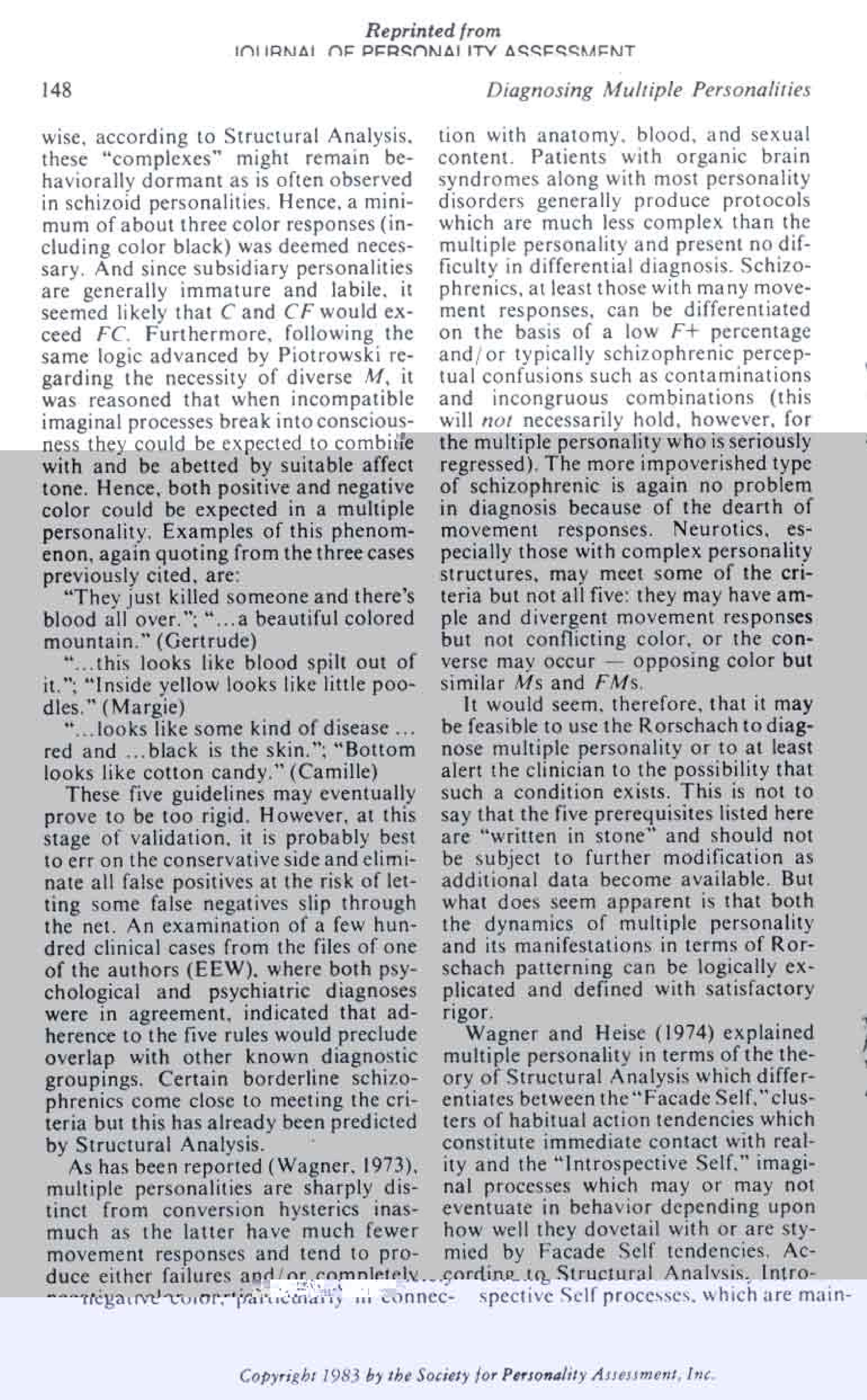
These five guidelines may eventually prove to be too rigid. However, at this Stage of validation, it is probably best to err on the conservative side and elimi- nate all false positives at the risk of let- ting some false negatives slip through the net. An examination of a few hun- dred clinical cases from the files of one of the authors (EEW). where both psy- chological and psychiatric diagnoses were in agreement, indicated that ad- herence to the five rules would preclude overlap with other known diagnostic groupings. Certain borderline schizo- phrenics come close to meeting the cri- teria but this has already been predicted by Structural Analysis.
As has been reported (Wagner, 1973), multiple personalities are sharply dis- tinct from conversion hysterics inas- much as the latter have much fewer movement responses and tend to pro-
duce either failures and/or comnletely __ SA STELAINE CUIOr paructiany a CONNEC-
Diagnosing Multiple Personalities
tion with anatomy, blood, and sexual content. Patients with organic brain syndromes along with most personality disorders generally produce protocols which are much less complex than the multiple personality and present no dif- ficulty in differential diagnosis. Schizo- phrenics, at least those with many move- ment responses, can be differentiated on the basis of a low F+ percentage and/or typically schizophrenic percep- tual confusions such as contaminations and incongruous combinations (this will mor necessarily hold, however, for the multiple personality who is seriously regressed), The more impoverished type of schizophrenic is again no problem in diagnosis because of the dearth of movement responses. Neurotics, es- pecially those with complex personality structures, may meet some of the cri- teria but not all five: they may have am- ple and divergent movement responses but not conflicting color, or the con- verse May occur — Opposing color but similar Ms and FMs, |
It would seem, therefore, that it may be feasible to use the Rorschach to diag- nose multiple personality or to at least alert the clinician to the possibility that such a condition exists. This is not to say that the five prerequisites listed here are “written in stone” and should not be subject to further modification as additional data become available. But what does seem apparent ts that both the dynamics of multiple personality and its manifestations in terms of Ror- schach patterning can be logically ex- plicated and defined with satisfactory rigor.
Wagener and Heise (1974) explained multiple personality in terms of the the- ory of Structural Analysis which differ- entiates between the “Facade Self,” clus- ters of habitual action tendencies which constitute immediate contact with real- ity and the “Introspective Self.” tmagi- nal processes which may or may not eventuate in behavior depending upon how well they dovetail with or are sty- mied by Facade Self tendencies, Ac-
cording to Structural Analvsis. Intro- spective Self processes, which are main-
Copyright 1983 by the Socsety for Personality Atsesiment, Inc
Page 7
Reprinted from INUIANAL OF PERSONA! ITV ASSESCMENT wise, according to Structural Analysis. these “comnlexes” micht remain he-
Diagnosing Multiple Personalities
tion with anatomy, blood, and sexual content.
Patients with organic brain
E. E, WAGNER, R. B. ALLISON, and C. F. WAGNER 149
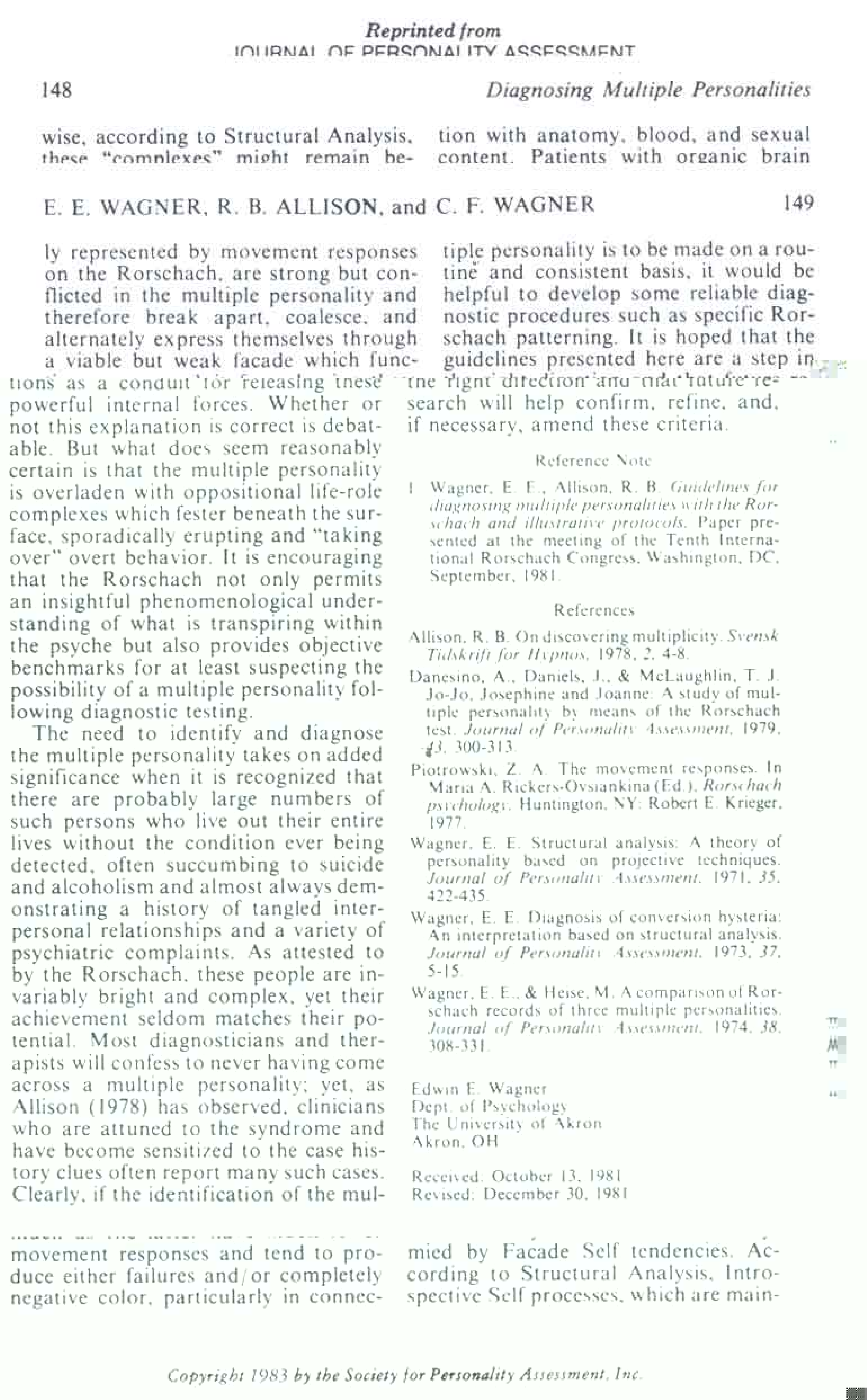
ly represented by movement responses on the Rorschach, are strong but con- flicted in the multiple personality and therefore break apart. coalesce. and alternately express themselves through a Viable but weak facade which func-
tiple personality ts to be made on a rou- tiné and consistent basis. it would be helpful to develop some reliable diag- nostic procedures such as specific Ror- schach patterning. [It is hoped that the lOMS as a CONnduUIL lor Teleasing ines?’ powerful internal forces. Whether or not this explanation ts correct is debat- able. But what does seem reasonably certain is that the multiple personality is overladen with oppositional life-role complexes which fester beneath the sur- face, sporadically erupting and “taking over” overt behavior. It is encouraging that the Rorschach not only permits an insightful phenomenological under- standing of what is transpiring within the psyche but also provides objective benchmarks for at least suspecting the possibility of a multiple personality fol- lowing diagnostic testing.
The need to identify and diagnose the multiple personality takes on added significance when it is recognized that there are probably large numbers of such persons who live out their entire lives without the condition ever being detected, often succumbing to suicide and alcoholism and almost always dem- onstrating a history of tangled inter- personal relationships and a variety of psychiatric complaints. As attested to by the Rorschach. these people are in- variably bright and complex, yet their achievement seldom matches their po- tential, Most diagnosticians and ther- apists will confess to never having come across a multiple personality; vet, as Allison (1978) has observed, clinicians who are attuned to the syndrome and have become sensitized to the case his- tory clues often report many such cases. Clearly, if the identification of the mul-
sn oe oe a
movement responses and tend to pro- duce either failures and/or completely negative color, particularly in connec-
search will help confirm, refine, and, if necessary, amend these criteria.
Reference Note
[| Wagener. EF. Allison, R. Bo Guidefiies for davnesing oialiile personalinies wot the Ror: whach and ihetrative pratacols, Paper pre- sented at the meeting of the Tenth Interna- onal Rorschach Congress. Washington, DC, Seplember, [98]
References
Allison. R. B. Ondiscovering multiplicity. Svensdé Thiskeift for ivpatas, ue -, 4-4
Danesino, A.. Daniels, J. & McLaughlin, T. J Jo-Jo, Josephine aimed ‘oanne A study of mul- ple personality by means of the Rorschach test. Juda! of Personality dssessment, 1979, gf. 300-313
Piotrowski, Z. A. The movement responses. In Maria A. Rickers-Ovsiankina (Ed.). Rorschach pyechologs. Huntington, SV: Robert E. Krieger, [or
Wagner, E. E. Structural analysis: A theory of personality bused on projective techoiques. Journal of Personality Assessenent. VOT). 45 -435
Wagner, E. Eo Diagnosis of conversion hysteria: An interpretation based on structural analysis. Jovrnal of Persenalie Axvessnrent, 1973, 37, §-|§
Wagner, Eb. & Heise. M, Acompiarison ol Ror- schach records of three multiple personalities. Journal anf Personality Assessment. 974. 38, OK-3A]
Edwin FE. Wagner
Dept. of Paycholops The University of \kron Akron, OH
Reecwed. Octaber 13. Revised: December 30,
los k]
mied by Facade Self tendencies. Ac- cording to Structural Analysis, Intro- spective Self processes, which are main-
Copyright 1983 by the Socsety for Personality Asresiment, Ine
guidelines presented here are 4 step in». ‘tne Tignt diftectrom anu Mae Tature’ res -~
ye
Original Page Scans